How to Buy USDT in India (2026) – P2P vs Indian Exchanges, Costs, Tax and Risks
There are two main ways to buy USDT with rupees in India: P2P markets on Binance and Bybit, where you pay another user directly by UPI or bank transfer, and Indian exchanges, where you deposit rupees into the exchange and buy from its order book. Both are legal on platforms registered with FIU-IND. They differ in price, convenience, how TDS is handled and the risks you take. This overview helps you choose, then links to step-by-step guides.
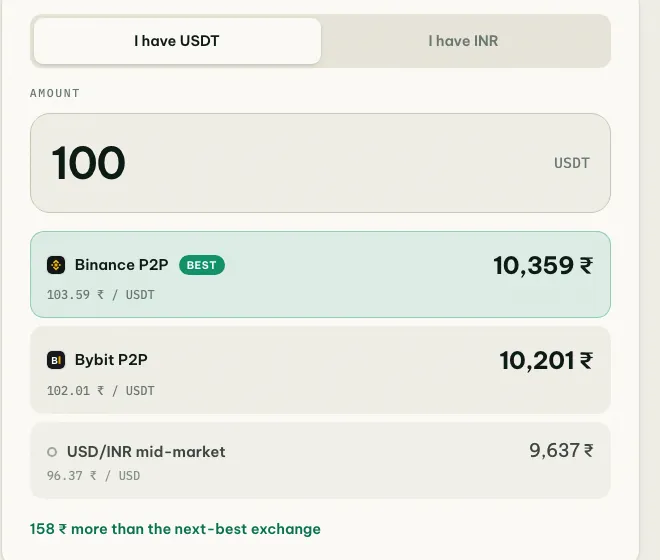
Today’s P2P price on Binance and Bybit: see the live USDT to INR rate.
The options at a glance
| P2P (Binance, Bybit) | Indian exchanges (order book) | |
|---|---|---|
| How you pay | UPI, IMPS, bank transfer to the seller | Deposit INR to the exchange by UPI or bank |
| Who you trade with | Another user, with exchange escrow | The exchange’s order book |
| Price | Set by P2P advertisers; varies by method | Set by the order book; check spread and fees |
| Exchange fee | Check current market/account fee | Trading fee per order |
| TDS | Buyer’s responsibility in law; check the order | Deducted by the exchange automatically |
| Bank-freeze risk | Higher, especially when selling | Lower: money goes to the exchange |
| Speed | Minutes, depends on the seller | Minutes once your deposit clears |
| Choice of withdrawal networks | Wide | Varies by exchange |
Option 1: P2P on Binance or Bybit
You choose an offer, pay the seller’s UPI ID or account from your own account, and the exchange releases USDT from escrow when the seller confirms.
Good for: most people who already use UPI, small and medium amounts, and anyone who wants to compare prices across many sellers and payment methods.
Watch for: paying only the account shown in the order, UPI daily limits, and, if you sell later, the bank-freeze risk from third-party payments.
Step by step: Binance P2P India and Bybit P2P India. Which one is cheaper: Binance vs Bybit P2P.
Option 2: Indian exchanges with INR deposits
Several Indian exchanges registered with FIU-IND let you deposit rupees through your bank or UPI and buy USDT on their INR market.
Good for: people who prefer not to deal with individual sellers, and those who want TDS handled automatically with a clear tax report.
Watch for: the trading fee and the order-book spread, which can make the effective price higher or lower than P2P depending on the day, deposit and withdrawal fees, and whether the exchange supports the withdrawal network you need. Check that the exchange appears on FIU-IND’s list of registered reporting entities.
What it costs
Whichever route you take, compare the total: price × amount, plus fees, plus any withdrawal fee.
- On P2P, the payment method matters: UPI and bank transfer are usually cheapest, PhonePe, Paytm and Google Pay often dearer. See UPI prices.
- On exchanges, add the trading fee to the order-book price.
- USDT in India usually costs several percent more than the dollar rate. See why USDT costs more than the dollar rate.
Tax: the same either way
- Gains when you later sell or swap USDT are taxed at 30% plus cess, with no set-off of losses.
- 1% TDS applies to transfers above yearly thresholds. Exchanges deduct it automatically; on P2P the buyer is responsible in law.
- Report in Schedule VDA and claim TDS credit from Form 26AS / AIS.
Details and examples: 1% TDS and 30% tax on crypto. Calculator: crypto tax calculator.
Risks to know
- Bank account freezes after cyber-crime complaints, mainly when selling on P2P. See P2P safety in India.
- Unregistered platforms can be blocked. Use FIU-IND-registered exchanges. See is crypto legal in India.
- Off-platform dealers on Telegram and WhatsApp offer no protection.
- Wrong network withdrawals can lose funds. See which USDT network to use.
- Price risk: USDT’s rupee price includes a premium that can shrink.
Which should you choose?
| Your situation | Suggested route |
|---|---|
| First purchase, small amount, you use UPI | P2P on Binance or Bybit, by UPI |
| Large amount | P2P by IMPS with a verified merchant, or an Indian exchange; compare totals |
| You want TDS handled for you | An Indian exchange |
| You need a specific withdrawal network | Check which platform supports it first |
| You’ll sell USDT for rupees often | Read how to sell USDT for INR safely before you start |
This is general information as of October 2026, not financial or tax advice. Crypto products are unregulated and can be highly risky.
Check the current Binance P2P fee schedule and the order confirmation. Taker fees can depend on the fiat market and account, so the quoted price is not necessarily the total cost. Add any applicable fee, payment charge and withdrawal cost separately.