Why USDT Costs More Than the Dollar Rate in India
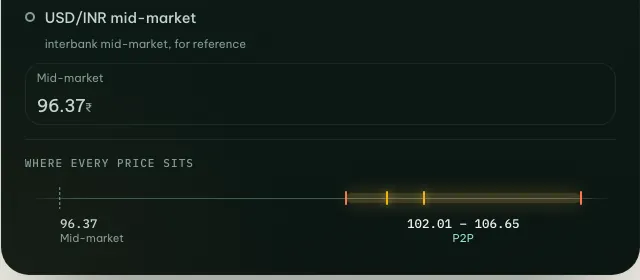
USDT is designed to be worth one US dollar. So why does 1 USDT on Indian P2P markets usually cost several rupees more than the USD/INR rate in the news, often 5–8% more? The short answer: the USDT price in India isn’t set by banks. It’s set by buyers and sellers on P2P, and India’s tax rules and banking risks make selling USDT for rupees expensive and risky, so sellers charge for it.
Compare live: the coinglee board shows Binance and Bybit P2P prices next to the USD/INR mid-market rate, and the P2P premium index tracks the gap daily.
Who sets the price
There’s no official USDT/INR rate. The prices on Binance and Bybit P2P are set by advertisers in their own offers. The “market price” is where the best offers sit at that moment. Because Indian P2P has fewer sellers than buyers most of the time, sellers can price above the dollar rate.
Why the premium is higher in India than in many countries
- The 30% tax and 1% TDS. Gains on crypto are taxed at a flat 30% plus cess, losses can’t be set off, and 1% TDS applies to transfers. Merchants who buy and sell USDT all day build these costs into their prices.
- Bank-freeze risk. Sellers receive rupees from strangers. If any payment turns out to come from fraud, a cyber-crime complaint can freeze their bank account, sometimes for weeks. That risk is priced in.
- Limited supply of USDT for rupees. Fewer people want to sell USDT for INR than want to buy it, and exchanges don’t offer a direct bank on-ramp at the dollar rate for most users.
- Demand for dollars. People use USDT to pay overseas services, receive freelance payments, invest abroad and trade crypto. All of this creates demand for USDT that the banking system doesn’t serve as easily.
- Crypto market mood. When crypto rallies, more people buy USDT to enter the market and the premium rises.
Reading the premium
On coinglee, premium = cheapest USDT buy price ÷ USD/INR mid-market − 1.
- In India a premium of several percent is normal.
- A rising premium means stronger demand or fewer sellers, for example during a crypto rally.
- A falling premium means more sellers or weaker demand.
Track it on the premium index, and compare with Vietnam and Pakistan on USDT premium by country. India’s is usually the highest of the three.
The buy–sell spread
P2P always has two prices: what you pay to buy USDT and what you receive when you sell it. In India the spread can be wider than elsewhere, because of the same tax and freeze risks. Buying and immediately selling back can cost one or two rupees per USDT. See the converter.
What this means for you
- Buying USDT to hold costs you the premium up front. If the premium falls later, the rupee value of your USDT falls with it, even if the dollar rate doesn’t move.
- Selling USDT you received from abroad gets you the premium, which is why many freelancers sell on P2P.
- Tax is calculated on rupee gains, so premium changes affect your taxable gain. Use the crypto tax calculator.
Why not just use the first offer?
The top offer often has a great price but a tiny limit, or comes from an account with few trades. So coinglee works out a price you can actually get:
- Only offers that accept a trade of about ₹20,000.
- Only advertisers with 95%+ completion and 50+ orders.
- The middle value of the 5 best remaining prices.
Prices refresh every 3 minutes. The full method is on the methodology page.
A premium can change without USDT changing its dollar value
Consider an illustrative USD/INR benchmark of ₹100 and a USDT buy price of ₹106. The premium is 6%. If USDT later costs ₹103 while the benchmark stays at ₹100, the premium falls to 3%. Someone holding 100 USDT has lost ₹300 of quoted rupee value, even if USDT still trades near one dollar globally. This is local price risk, separate from a loss of USDT’s dollar peg.
The benchmark can move too. If both prices rise together, the rupee cost may increase while the percentage premium remains unchanged. Compare timestamps, payment methods and trade sizes before attributing a movement to taxes or demand. Those are possible explanations, not facts proven by the chart. A historical premium is an observation; it doesn’t guarantee a future price or a risk-free arbitrage opportunity.