Why Is USDT More Expensive Than the Dollar Rate in Pakistan?
USDT is designed to be worth one US dollar. Yet in Pakistan, P2P USDT almost always costs more rupees than the interbank dollar rate you see in the news, often 2–3% more. It isn’t a mistake or a scam. It reflects how hard it is to get dollars through banks, and how many people want them.
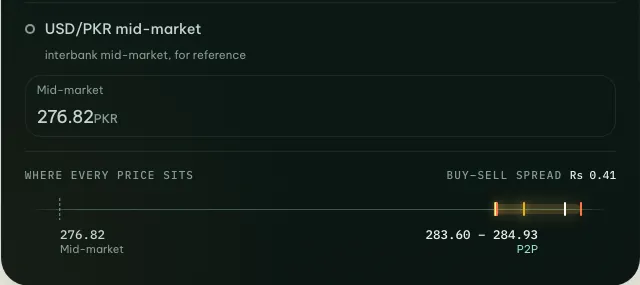
Compare live: the coinglee board shows each exchange’s USDT price next to the USD/PKR mid-market rate, and the P2P premium index tracks the gap every day.
Who sets the price
There’s no official USDT/PKR rate. Prices on Binance, OKX and Bybit P2P are set by thousands of buyers and sellers in their own offers. The “market price” is where the best offers sit at that moment. When more people want to buy than sell, sellers raise prices; when sellers outnumber buyers, prices fall.
Three dollar rates in Pakistan
| Rate | What it is | Can you use it? |
|---|---|---|
| Interbank (mid-market) | The rate banks trade at with each other | Not directly as an individual |
| Open market | What exchange companies charge for cash dollars | Yes, at exchange companies, with documentation |
| P2P USDT | What people pay each other for USDT | Yes, on P2P markets |
coinglee compares USDT with the mid-market rate because it’s the cleanest benchmark. In practice USDT usually trades near or above the open-market dollar. See USDT vs open-market dollar for that comparison.
Why the premium exists
- Access to dollars. Buying dollars through a bank or exchange company needs documentation and has limits. USDT needs only an exchange account, so people pay extra for easy access.
- Protection against rupee depreciation. Savers who expect the rupee to weaken keep part of their money in dollars, and USDT is the easiest way to do that digitally.
- Freelancers and remittances. Many people receive USDT from abroad and sell it, while others buy it to pay for services and imports. The balance between them moves the price.
- Risk. Bank account freezes, fraud and regulatory uncertainty make P2P riskier than a bank, and merchants charge for that risk.
- Crypto market mood. When Bitcoin rallies, people buy USDT to enter the market and the premium rises.
Reading the premium
On coinglee, premium = cheapest USDT buy price ÷ USD/PKR mid-market − 1.
- A premium of 2–3% is normal in Pakistan.
- A sudden jump usually means heavy demand, for example after a rupee move or crypto rally, or fewer sellers.
- A falling premium means more sellers or less demand.
Track it on the premium index, and compare with other countries on USDT premium by country.
The buy–sell spread
P2P always has two prices: what you pay to buy USDT and what you receive when you sell. The gap is the merchants’ margin and the cost of a round trip, usually a fraction of a rupee to about a rupee per USDT on bank transfer, wider on wallets. A tight spread means a competitive market.
Why not just use the first offer?
The top offer in the list often has a great price but a tiny limit, or comes from an account with few trades. If you want to buy Rs 50,000 worth, you can’t use it. So coinglee works out a price you can actually get:
- Only offers that accept a trade of about Rs 50,000.
- Only advertisers with 95%+ completion and 50+ orders.
- The middle value of the 5 best remaining prices.
Prices refresh every 3 minutes. The full method is on the methodology page.
Common questions
Is it better to buy dollars at an exchange company? If you need physical cash and have documents, compare the open-market rate with USDT on the day. USDT is easier to send abroad and hold digitally.
Why does selling USDT give more rupees than the dollar rate? Because buyers on P2P pay the premium. That’s why freelancers often sell USDT on P2P; see Payoneer or USDT for Pakistani freelancers.
Compare buying dollars with buying USDT separately
Suppose the illustrative dollar benchmark is Rs 280 and a USDT buy offer is Rs 286. The USDT premium is about 2.14%. That doesn’t mean you could buy dollars at Rs 280 and immediately sell USDT for a guaranteed profit. The benchmark may not be a retail rate, and converting money across accounts, jurisdictions and platforms introduces costs and restrictions.
For someone spending Rs 50,000, the practical question is the final USDT quantity at an offer that accepts their payment method and amount. For someone selling 100 USDT, use the sell quote instead. Compare observations from the same time and label any historical example with its date. A changed premium alone cannot tell you whether the dollar rate, local supply or advertiser prices moved first.