How to Sell USDT for VND on P2P Safely (Binance, OKX, Bybit)
Legal notice: since 1 September 2026, under Decree 284/2026/ND-CP, individuals in Vietnam who trade crypto-assets other than through a provider licensed by the Ministry of Finance can be fined 30–50 million dong. Binance, OKX and Bybit are not licensed in Vietnam. coinglee provides price information for reference only.
Selling USDT on P2P flips the roles of buying: the buyer sends dong to your bank account first, you check it, and only then do you release the USDT. The exchange holds your USDT in escrow while the order is open, so the buyer can’t take it without your confirmation. That puts you in control, and also makes you the target of nearly every P2P scam. One rule covers most of it: release only after the money is actually in your bank account, in full, from the buyer’s own name.
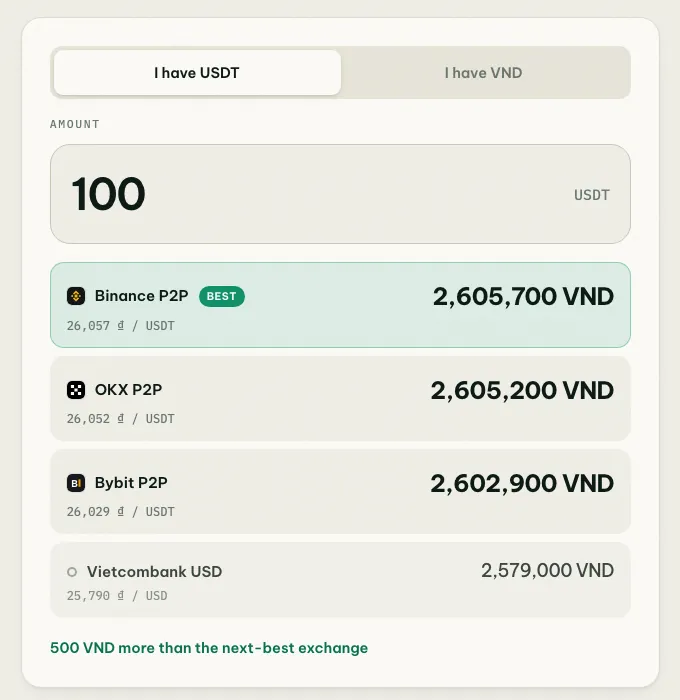
The best selling price right now is in the “You sell USDT” column of the USDT board. To see what your USDT is worth at each exchange, use the converter.
Before you sell
- Pick the exchange with the best selling price. The selling side often differs by 10–30 dong per USDT between exchanges. On 5,000 USDT, that’s 50,000–150,000 dong.
- Receive into a bank account in your own name, the same name as your exchange verification, and add it as a P2P payment method.
- Consider a separate account for P2P. If a buyer’s money turns out to be from a scam, the bank may freeze the receiving account. A separate account may reduce disruption to salary and bill payments, but it does not protect any account from a bank review or investigation.
- Make sure your phone is nearby for the whole order. You’ll need to check your bank app and confirm with 2FA.
Step 1: Move USDT to the P2P wallet
USDT for P2P selling must be in the right place: the Funding wallet on Binance, the Funding account on OKX and Bybit. If it’s in Spot or a trading account, move it with an internal transfer first. It’s free and instant.
Step 2: Choose a buyer
Open P2P → Sell → USDT → VND, enter how much you want to sell and choose bank transfer (or the e-wallet you want to be paid in). Look for buyers who:
- Have 95%+ completion and plenty of orders in the last 30 days.
- Are verified merchants, especially for larger amounts.
- Have limits that let them pay your whole amount in one transfer.
- Have a short average payment time.
The highest price isn’t always the best choice. A slightly lower price from an established merchant usually means a faster, cleaner trade.
Step 3: Wait for the payment
When the order opens, your USDT is locked in escrow. The buyer has a payment window, usually 15 minutes, to transfer the money and mark the order as paid. Don’t release anything during this time, even if the buyer messages that they’ve “already paid”.
Step 4: Check the money yourself
When the buyer marks the order as paid:
- Open your own banking app and look at the balance and the incoming transfer. Screenshots, SMS and emails can all be faked in seconds.
- Check that the amount matches the order exactly.
- Check that the sender’s name matches the buyer’s verified name in the order.
- Check that it’s one transfer from one account, not several pieces from different people.
If the name doesn’t match, don’t release. This is the classic triangle scam: the scammer pays you with a third victim’s money, takes your USDT, and the victim’s complaint later leads to your account. Open an appeal in the order, preserve the payment evidence and get official bank and exchange instructions before any refund. Full details: triangle scams and fake payment proof.
Step 5: Release the USDT
Once the full amount is in your account from the right name, tap Release (or Confirm received) and confirm with 2FA. The trade is final. There’s no way to take the USDT back after release, which is why steps 3 and 4 matter.
Selling large amounts
- Split into several orders with different established buyers rather than one huge order. Banks are more likely to review very large incoming transfers.
- Use a buyer whose limit fits each order, so each order is paid in one transfer.
- Expect bank checks. Vietnamese banks may ask where large or frequent incoming transfers come from. Keep your P2P order history so you can explain.
What you actually receive
The selling price is per USDT. Start with amount × price, then account for any actual order fee, tax or payment charge. The spread matters if you later buy USDT back, but it is not the only possible cost. The converter shows both sides.
If something goes wrong
| Situation | What to do |
|---|---|
| Buyer marked paid but nothing arrived | Don’t release. Wait a few minutes for interbank delays, then appeal with a screenshot of your bank history |
| Money arrived from a different name | Don’t release. Appeal and get bank and exchange instructions before any refund |
| Buyer paid less than the order | Don’t release. Ask them to pay the rest or refund and cancel through support |
| Buyer pressures you or threatens to report you | Ignore it and appeal. Support decides on evidence, not pressure |
| Your bank froze your account after a sale | See bank account frozen after P2P |
Never
- Release before the money shows in your banking app, however hard the buyer pushes.
- Accept money from someone else’s account, or split payments from several accounts.
- Move the conversation to Zalo, Telegram or anywhere off-platform.
Since 1 September 2026, trading crypto-assets in Vietnam other than through a licensed provider can be fined 30–50 million dong (Decree 284/2026/ND-CP). See Vietnam crypto regulation 2026.