Binance, OKX and Bybit P2P Fees in Vietnam – What Buying USDT Really Costs
Legal notice: since 1 September 2026, under Decree 284/2026/ND-CP, individuals in Vietnam who trade crypto-assets other than through a provider licensed by the Ministry of Finance can be fined 30–50 million dong. Binance, OKX and Bybit are not licensed in Vietnam. coinglee provides price information for reference only.
“Are there fees for buying USDT on P2P?” The short answer: check the current fee for your market and account before taking an offer. But that doesn’t make P2P free. Your real cost hides in the price you accept, the spread between buying and selling, the payment method you use and any withdrawal. This guide breaks down each item and shows how to work out what a trade really costs.
Compare live prices on the USDT rate board or see which exchange has had the cheapest USDT over the last 7 and 30 days.
1. Exchange P2P fees
| Binance P2P | OKX P2P | Bybit P2P | |
|---|---|---|---|
| Taking an existing offer (most users) | Check market/account fee | Check current fee | Check current fee |
| Posting your own offer (merchants) | May have a maker fee, depending on currency | May have a fee | May have a fee |
| Depositing VND | None: you pay the seller directly | None | None |
| Moving USDT inside the exchange | Free | Free | Free |
Check the current Binance P2P fee schedule and the order confirmation. Taker fees can depend on the fiat market and account, so the quoted price is not necessarily the total cost. Add any applicable fee, payment charge and withdrawal cost separately.
2. The price you accept: the biggest cost
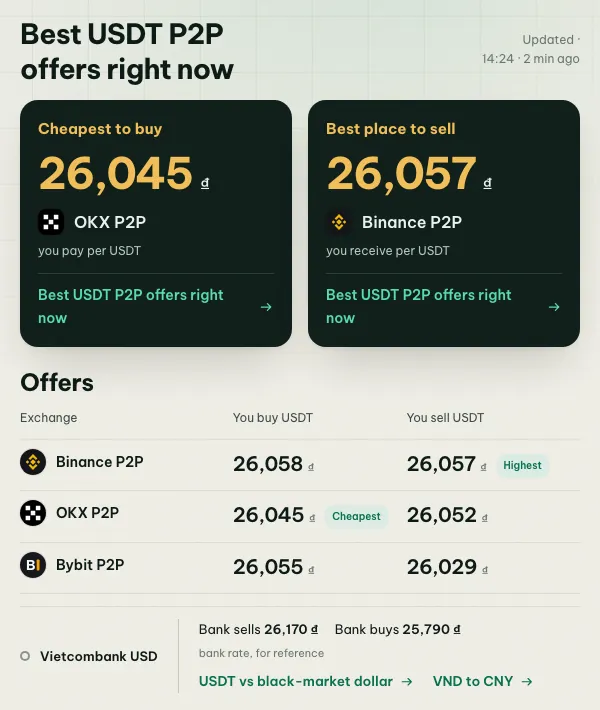
At any moment, the buy price on Binance, OKX and Bybit can differ by 10–50 dong per USDT, and the best exchange changes during the day.
| Amount | Gap of 10 dong | Gap of 30 dong | Gap of 50 dong |
|---|---|---|---|
| 500 USDT | 5,000 ₫ | 15,000 ₫ | 25,000 ₫ |
| 2,000 USDT | 20,000 ₫ | 60,000 ₫ | 100,000 ₫ |
| 10,000 USDT | 100,000 ₫ | 300,000 ₫ | 500,000 ₫ |
Compare the price and every applicable fee together. Within one exchange, the gap between a well-priced offer and the first one you see can be just as large.
3. The buy–sell spread
Buy and sell quotes can differ, but the displayed spread is not fixed and the offers may have different limits. If you buy USDT and later sell it back, you lose that gap, typically a few dozen dong per USDT on bank transfer. It matters if you:
- buy USDT for a short time, for example to pay someone, and they sell it right away;
- move in and out of USDT often.
The converter and each amount page show the spread cost for that amount.
4. Payment method premium
Offers that accept MoMo, ZaloPay or Viettel Money are usually a little more expensive than bank transfer, because fewer sellers accept them. The difference is often a few dozen to around a hundred dong per USDT. See prices by payment method.
5. Bank and e-wallet transfer fees
Instant transfers between Vietnamese banks (NAPAS 247) are free for most personal accounts, but some banks and account packages still charge. E-wallets may charge for topping up from or withdrawing to a bank. Check your own plan.
6. Withdrawal network fees
You only pay this if you move USDT out of the exchange:
| Network | Typical withdrawal fee |
|---|---|
| TRC20 (Tron) | around 1 USDT |
| BEP20, Solana, TON | well under 1 USDT |
| ERC20 (Ethereum) | several USDT |
If you keep or sell your USDT on the exchange, there’s no network fee. See which USDT network to use.
Worked example: buying 2,000 USDT and withdrawing it
| Item | Choice | Cost |
|---|---|---|
| Exchange fee | Take an existing offer | Add the actual applicable fee |
| Price | Cheapest exchange vs a 30-dong-dearer one | Saves 60,000 ₫ |
| Payment method | Bank transfer instead of MoMo (60 dong/USDT) | Saves 120,000 ₫ |
| Bank transfer | NAPAS 247, personal account | Usually 0 |
| Withdrawal | BEP20 or TRC20 instead of ERC20 | Saves a few USDT |
The size of each cost depends on your order. The choices you make, which exchange, which payment method and which network, can easily add up to 200,000 dong or more on a 2,000 USDT purchase.
Ways to pay less
- Compare exchanges before every trade instead of always using the same one.
- Use bank transfer for anything above a small amount.
- Filter by your amount so you only see offers you can actually use.
- Avoid thin hours. The price history shows which days and hours are usually cheapest.
- Ignore offers that look too good. They usually have tiny limits, very new accounts, or are scams.
- Withdraw on a cheap network and only when you need to.
This is general information; exchange fees and policies can change at any time. Since 1 September 2026, trading crypto-assets in Vietnam other than through a licensed provider can be fined (Decree 284/2026/ND-CP).