Why Is USDT Priced Differently from the Bank's USD Rate in Vietnam?
Legal notice: since 1 September 2026, under Decree 284/2026/ND-CP, individuals in Vietnam who trade crypto-assets other than through a provider licensed by the Ministry of Finance can be fined 30–50 million dong. Binance, OKX and Bybit are not licensed in Vietnam. coinglee provides price information for reference only.
USDT is a digital token designed to be worth one US dollar. So why does 1 USDT in Vietnam rarely cost exactly what your bank charges for 1 USD, and sometimes cost more? The short answer: there is no official USDT/VND rate. The price comes from people trading with each other on P2P markets, and it reflects how much demand there is for dollars outside the banking system.
Compare live: the USDT board shows each exchange’s USDT price next to Vietcombank’s USD rate, and the P2P premium index tracks the gap every day.
Who sets the price
On Binance, OKX and Bybit P2P, hundreds of merchants and individuals post offers to buy or sell USDT for dong. Each sets their own price. The “market price” is simply where the best offers sit at that moment.
- When many people want USDT, during a crypto rally or when people want to move savings into dollars, sellers raise their prices.
- When many people want to sell USDT for dong, for example to pay bills or take profit, buyers can bid lower.
- Merchants who trade full-time keep prices close to each other across exchanges, because anyone can buy on one and sell on another if the gap gets big.
Compared with the bank rate
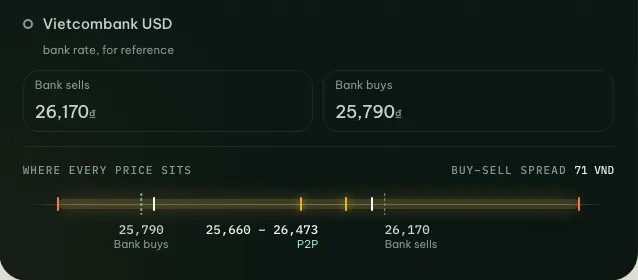
Vietcombank publishes two main USD rates:
| Bank rate | Meaning | Who uses it |
|---|---|---|
| Selling rate | What you pay the bank for 1 USD | You, buying dollars |
| Transfer buying rate | What the bank pays you for 1 USD | You, selling dollars |
USDT usually trades between these two numbers. On coinglee, “premium” means the cheapest USDT buy price compared with the bank’s selling rate:
premium = cheapest USDT buy price ÷ Vietcombank USD selling rate − 1
A negative premium means USDT is cheaper than buying dollars at the bank; a positive one means it’s more expensive.
What moves the premium
- Access to dollars. Buying USD at a Vietnamese bank needs a reason and paperwork, such as study abroad, travel or medical bills. USDT has no such requirement, so when demand for “easy dollars” rises, the premium rises.
- Crypto market mood. When Bitcoin and other coins rally, people buy USDT to enter the market, and the premium goes up. Sharp sell-offs push it down.
- Regulation and risk. News about bank account freezes, new rules or exchange restrictions changes how much merchants charge for the risk they take. Since September 2026, fines for trading on unlicensed platforms are part of that risk.
- Time of day and week. Liquidity is thinner late at night and at weekends, which widens spreads. The price history shows when in the week USDT is usually cheapest.
The buy–sell spread
P2P always has two prices: what you pay to buy USDT and what you receive when you sell it. The gap is the merchants’ margin and the cost of a round trip. It’s usually a few dozen dong per USDT on bank transfer, and wider on e-wallets. A tight spread means a competitive market.
Why not use the top offer?
The first offer in the list often has the best price but a limit of a few hundred thousand dong, or comes from an account with few completed trades. If you want to buy a few million dong’s worth, you can’t use that price. So coinglee works out a price you can actually get:
- Only offers that accept a trade of about 5 million VND.
- Only advertisers with 95%+ completion and 50+ orders.
- The middle value of the 5 best remaining prices.
Data refreshes every 3 minutes. See the methodology for the details.
Common questions
Is USDT always 1 dollar? On global exchanges it trades very close to 1 USD. The local price in dong depends on local supply and demand, which is why it differs from the bank rate.
Is a high premium a sign of a problem? Not necessarily. It usually means strong demand for dollars or crypto. A sudden jump can reflect news or a market move, so check the daily premium history.
How does Vietnam compare with other countries? See USDT premium by country. Pakistan and India often have a larger premium.
Use the correct side of the bank quote
A bank’s dollar sell rate describes buying dollars from the bank; its buy rate describes giving dollars to the bank. Cash and transfer rates may also differ. Match the direction before comparing them with a USDT buy or sell quote.
For a fixed VND budget, divide by the USDT buy price. For a fixed USDT holding, multiply by the sell price. These answer different questions. The comparison is a way to understand local prices, not evidence that you can exchange bank dollars and USDT without fees, account requirements or legal restrictions. Save both timestamps, since an older bank quote can make a current premium look misleading.